

click image above for the full program for King Hedley II
First Chicago Storefront Production
by August Wilson
Directed by Artistic Associate Manny Buckley
running time 3 hours, including a 10-minute intermission
Oct 16—Nov 29, 2026
“RECOMMENDED: An intimate and affecting production...the gutsiness of the production is pure Chicago storefront.”
“Director Manny Buckley knows exactly what he’s doing here, and he does it very well.”
“the writing is brilliant, the staging authentic, and the acting terrific...Go See it!”
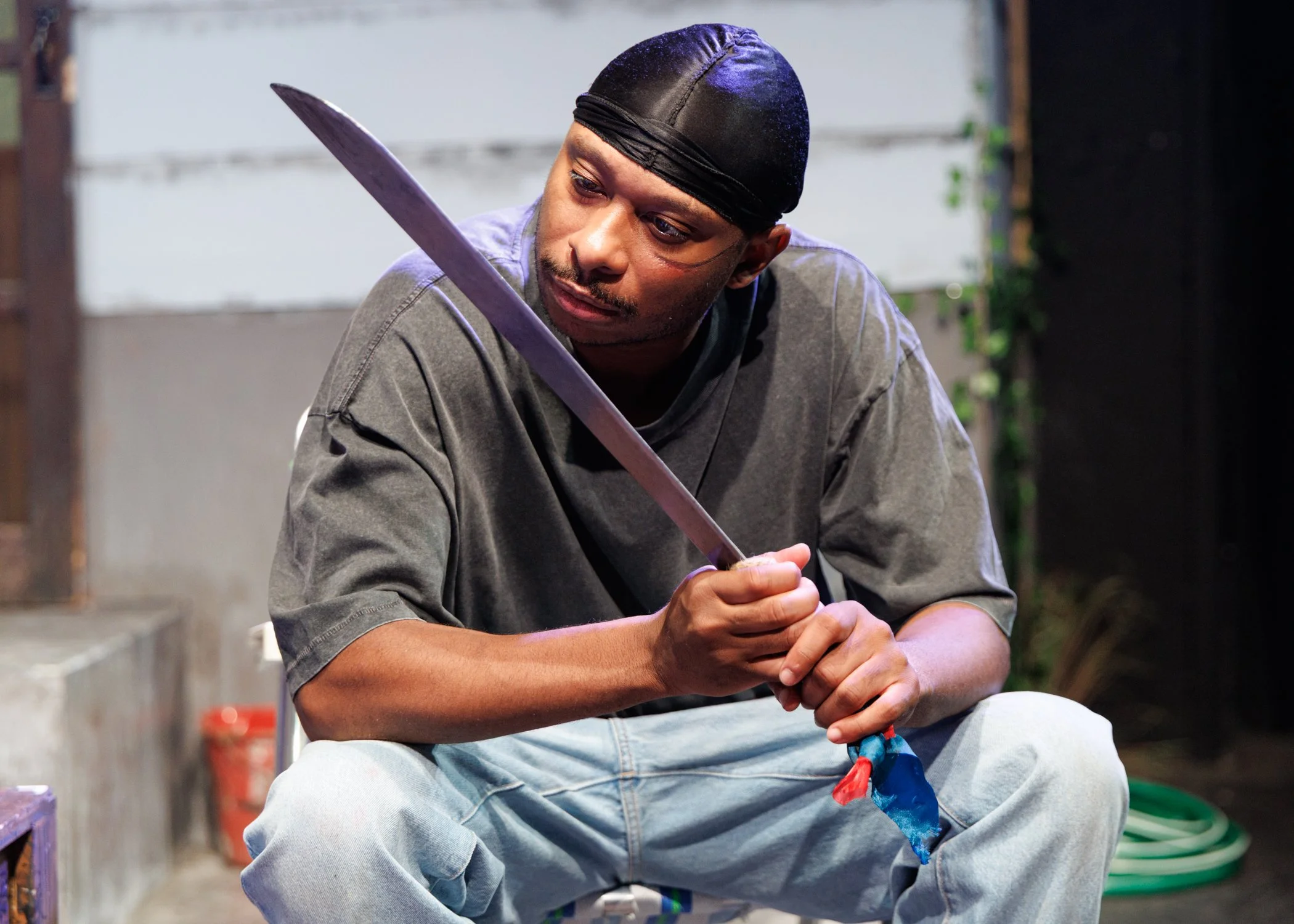
James Lewis as King, photos by Steven Townshend/Distant Era
“Tonya—a spectacular Isis Elizabeth”
“As Elmore, Jelani Julyus gives the savviest and slyest performance onstage ”
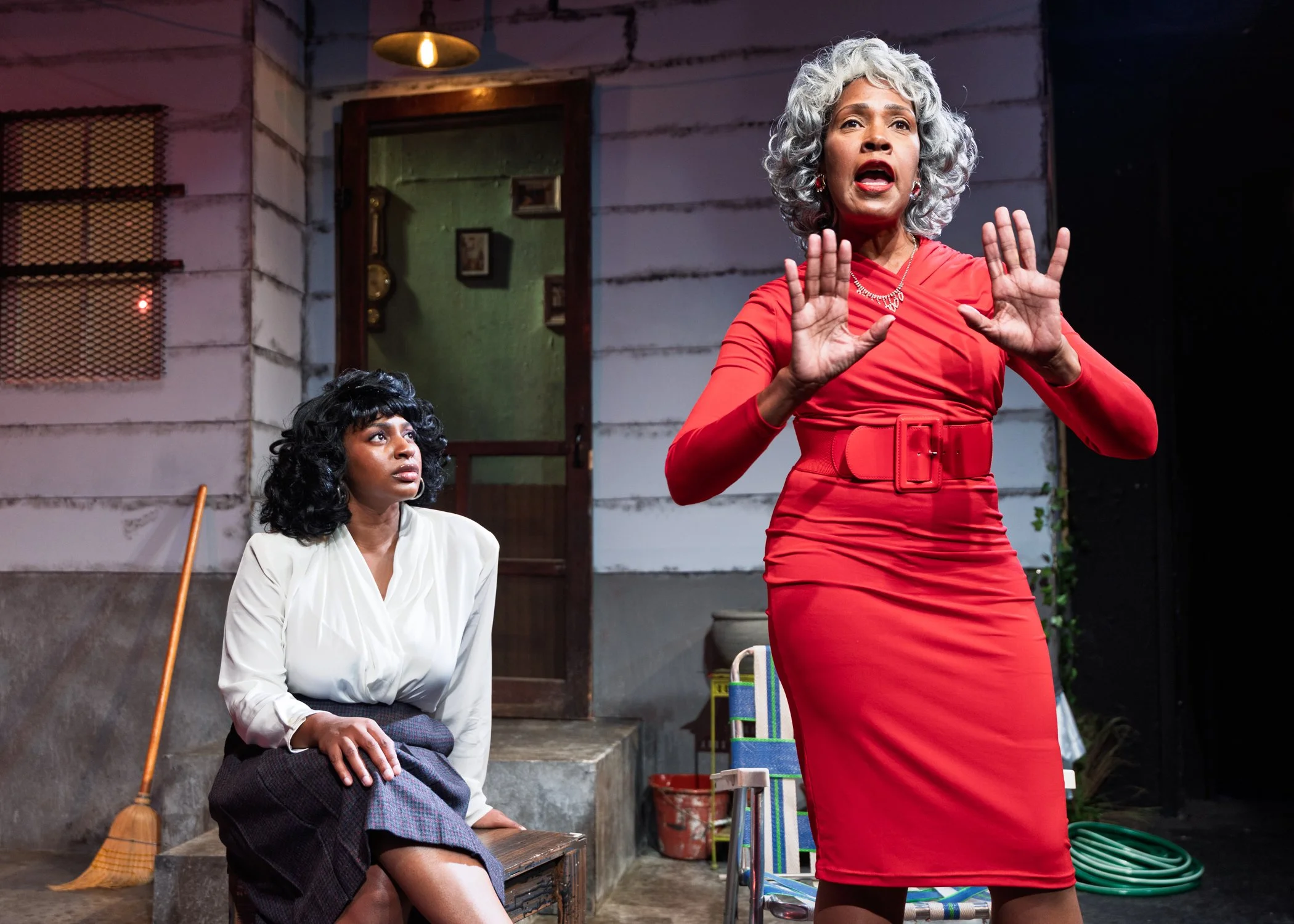
Isis Elizabeth as Tonya, Andrea Conway-Diaz as Ruby, photos by Steven Townshend
Revisiting characters established in August Wilson’s Seven Guitars, this play returns to Pittsburgh’s Hill District in 1985. King Hedley, a man recently released from prison, attempts to rebuild his life by selling stolen refrigerators so he can buy a video store. Despite decades of generational trauma, can King break free from the crippling socio-economic struggles that have held him down? Amid the realities of rampant crime and drug use in the neighborhood community, he tries to carve out his own destiny.
25th Anniversary of the Broadway Production
Cast




Crew
Manny Buckley (Director) a proud artistic associate, last directed City Lit’s Chicago storefront premiere of August Wilson’s Seven Guitars, 2024 Non Equity Jeff Award winner for best production. Credits include work with Playground Chicago, Chicago Shakespeare, Steppenwolf, Goodman, Shattered Globe, Bramble and American Blues Theater. Mr. Buckley has received nominations for the Joseph Jefferson Award, Helen Hayes Award and 3Arts Award; he is the recipient of a Black Theater Alliance Award and Black Excellence Award.
Brian Pastor (Executive Artistic Director) is a trans/non-binary director, actor, playwright, and Jeff Award-winning producer (Production—Play, August Wilson’s Seven Guitars) and the Executive Artistic Director of City Lit Theater. Brian previously spent ten and a half years on staff at City Lit, including nine as Managing Director. From 2019 to 2024, Brian served as City Lit’s Resident Director, where they directed last season’s R.U.R and Glassheart, as well as The Night of the Hunter, The Playboy of the Western World, Arms and the Man, J.B., and their own acclaimed adaptation of Robert Kennedy’s Thirteen Days. Brian is a founder and Emeritus Artistic Director of Chicago’s Promethean Theatre Ensemble, where they directed The Lion in Winter, The Winter’s Tale, and Gross Indecency: The Three Trials of Oscar Wilde (all Broadway World Award Nominated—Best Director), as well as Henry V and The Dark Side of the Bard. Love to Joshanna and the kitties.
Devi Angel (Asst. Stage Manager) is an intern working at City Lit while finishing their senior year at Lake Forest College. Devi is a theater lover, actor, director, and playwright who studies the relationship between theater, philosophy, and storytelling. Devi is working at City Lit to expand their understanding of what it means to make a theater company work by working in the administration office and assistant stage managing for Shane and King Hedley II.
Jeremiah Barr (Scenic Designer/Technical Director) A jack of all trades, carpenter, designer and artist Jeremiah is very excited to be working with the KH2 crew. Some of his past design credits include Shane (scenic/technical director), Sherlock Holmes and the Christmas Clowns (scenic design), Glassheart (scenic design) Strange Cargo (props/puppet design) with City Lit Theatre; St. Nicholas (scenic/props design) with Black Button Eyes. A big shout out to Samantha for all her love and knowledge of cats that keeps him on his toes.
Greg Geffrard (Intimacy & Violence Director) Selected previous credits: Ma Rainey’s Black Bottom, Brief Wondrous Life of Oscar Wao, The Color Purple (Goodman); Choir Boy (Steppenwolf Theatre); Two Sisters & A Piano, Hot Wing King, The Band’s Visit (Writer’s Theatre); Eureka Day! (Timeline); BOTH ( Teatro Vista); The Factotum (Lyric Opera); Confederates (Redtwist Theatre); The Mountaintop (Beverly Arts Center); Fen (Court Theatre).
Becca Holloway (Casting Director) (she/her) is thrilled to have cast this amazing team! Selected casting credits: Scaramouche (City Lit Theater), Indoor Cats, Hamlet, The Pilon, The Seagull (Red Theater), Wise Guys, Party At The Pantheon, Die Hard 4 Your Luv (Factory Theater), Romeo And Juliet, Love’s Labour’s Lost (Midsommer Flight). Aside from her work as a director and casting director, Becca is also the curator of the monthly Readings at Red series to help support and develop new plays written by Chicago local playwrights. Much love as always to CWW. IG: bwaybexy
Michael Lesko (Stage Manager) (he/him) This is Michael’s second production with City Lit following the recent Shane. Recent stage management credits include The Trojan Women (Eos Theatre), Bat Boy The Musical (Stage Wright), and Lyn Knottage’s Sweat (Loop Players). He has worked various roles throughout his career as an actor, sound designer, and stage carpenter. He wants to thank his family and friends for their endless support.
Mike McShane (Lighting & Sound Designer) is a theatrician practicing design in Chicago since 2019. Previous designs at City Lit Theater include August Wilsons’ Seven Guitars, T.S. Eliot’s Murder in the Cathedral, Waiting for Tina Meyer and Text Me. mikemcshane.weebly.com
Andres Mota (Costume Designer) is a Mexican costume designer who holds a bachelor’s degree in Theatre from the National School of Theater Arts in Mexico City. Mexico credits include El Casamiento, Opción Múltiple, and Aura (National Institute of Fine Arts, opera version); the short films Verónica and Adiós Hamburgo (Argos Productions); and En el Ombligo de la Luna (Contempo-Danza). Chicago credits include Buried Child (AstonRep Theatre Company), A Christmas Carol (Metropolis Performing Arts Centre), American Son (Ghostlight Ensemble Theatre Company), and Latin History for Morons, Touching the Void, and Jane Austen in 89 Minutes! (StageWorks Theatre Tampa). Andrés is thrilled to return to CityLit Theater as the costume designer for King Hedley II.
Melanie Thompson (Props Designer) is a Chicago-based freelance artist. You’ve seen her work with AstronRep, Oak Park Festival Theatre, Black Button Eyes Productions, 16th Street Theatre, Pride Films and Plays, Erasing the Distance, Dominican University and many others. She’s so delighted to join the crew at CityLit! She thanks her friends, family, Prince, Sheba, Winter, and Michael the turtle for their love and support.
Reviews
Manny Buckley’s commanding production
by C.J. Fernandes | stage & cinema.com | November 2, 2026
“If I’d been carrying twenty pounds of potatoes maybe I would have went home a shorter way.”
A fading mural of Willie Mays peeks from a corner onto two weathered houses in Pittsburgh. The year is 1985, Reaganomics is in full flower, and in his backyard in the Hill District, King Hedley the Second (James Lewis) is fuming. Still recovering from a stint in prison, King is determined to set his life to rights. His dream, shared with his best friend Mister, is to own a video store. And one has just popped up on the market. King and Mister (Ernest Henton) need $10,000 to buy in, but King’s boss just had his contract bid rejected by City Hall and Mister’s boss keeps delaying his promised raise. Desperate to raise money, King and Mister have taken to selling boosted refrigerators. They’re only $300, from GE, and state of the art; they just can’t make ice.
August Wilson’s King Hedley II, the ninth play in his Pittsburgh Cycle, is the second offering from City Lit in its 46th season. Jeremiah Barr’s charming set features the back porches of two houses, one occupied by the Hedley family and the other by an older gentleman called Stool Pigeon (Brandon Boler), who fancies himself a prophet. A raised plant bed completes the yard. It is currently bare, but King is determined to grow flowers in it despite the misgivings of his birth mother Ruby (Andrea Conway-Diaz), who insists that the dirt isn’t good enough: “You need good dirt to make things grow.” King fires back in resentment, “This is the only dirt I got.”
The above exchange should tell you a bit about the tone of the play to follow. King Hedley II is unabashedly theatrical. Its metaphors are overt and its performances are big and brash; occasionally too much so for the small City Lit space, particularly in the case of Lewis and Boler. The technical design leans into this classical theatricality: Mike McShane’s lighting design narrows to a spot for each performer during each monologue, and his sound design is on point as well. There’s also a marvelous (and unobtrusive) blues soundtrack that does a lot to set the scene. Director Manny Buckley knows exactly what he’s doing here, and he does it very well.
Raising the money for the video store is just one of King’s problems: his wife Tonya (a spectacular Isis Elizabeth) has just discovered she’s pregnant and is insisting on getting an abortion; he still cannot get over his former girlfriend Neesi, who was killed in a car crash while he was in prison for murder, and he’s just learned that the cousin of the man he killed is in town and has been inquiring as to his whereabouts. If that wasn’t all, Elmore (Jelani Julyus), a gambler who took King for everything he had the last time they met, is going to visit. Elmore is Ruby’s former lover, and he’s coming to Pittsburgh with more than gambling on his mind.
If you’ve seen or read Wilson’s Seven Guitars, you’ll recognize some of these names. Several characters are ported over from that story, and its plot influences the proceedings of King Hedley IIquite a bit, especially the final scenes. But knowledge of the earlier play is entirely unnecessary here. The brilliance of King Hedley II is that the backstories are unimportant in the larger scheme of things. The focus is on the vicious cycle of systemic poverty and violence that makes escape a near miracle. It also has fascinating insights regarding the American male’s perception of honor and masculinity, which ties it to City Lit’s previous slice of Americana, the superb Shane, set in a different era where these concepts take on an oversized importance. The most powerful portions of King Hedley II involve characters trying to convince King that he’s focusing on the wrong things in life. It’s hard to like King, and Lewis’s interpretation of the character makes him even more unlikeable, bringing his intransigence and anger to the fore at the expense of his more introspective qualities. But it works to the play’s benefit. His path of self-destruction cannot be halted, and Buckley’s direction makes the audience complicit as the people who love King try their best to save a man who stubbornly refuses to be saved.
King Hedley II is the sort of play that actors love, and with good reason. All the major parts are beautifully wrought, and each one of the principals gets a terrific monologue. The dialogue is more often than not a bit on the nose, but it’s beautifully constructed and allows the performers plenty of room for nuance. All the actors are great, but of the cast, Isis Elizabeth’s Tonya and Jelani Julyus’s Elmore made the strongest impression on me. Elizabeth is a tour de force in her blistering monologue (in the original Broadway production, Viola Davis won her first Tony for the same part), but she’s even better in the aftermath. As King barrels on toward tragedy, you can clock the moment where Tonya gives up on him, shifting her priorities to focus on things she can control. The love is still there, but she knows she can’t save him; a scene where she tries to convince him that she doesn’t need the things that he’s willing to kill himself to provide her is the emotional peak of the play, and it is devastating.
As Elmore, Jelani Julyus gives the savviest and slyest performance onstage. Beautifully costumed by Andres Mota in a dapper three-piece suit, Julyus uses his smooth baritone and megawatt smile to disguise his designs from the other characters as well as from the audience. It’s so well-crafted that it isn’t until well into the second act that we get a clue as to whether he’s one of the good guys, and even then, he keeps us on our toes until the climax. It’s a remarkable, multilayered performance that lingers long after the final curtain.
There’s a cruel irony in the mural of Willie Mays looking over the Hedleys’ backyard. Considered one of the greatest baseball players of all time, Mays grew up in Jim Crow Alabama and through his athletic excellence broke through racial barriers in a way that few would have anticipated, and he did it the prescribed way: by keeping his head down, not making a fuss, and simply being better than anyone else. But by his reluctance to participate in the civil rights movement, he also failed to give voice to the challenges that regular Black men and women—mere mortals—have to face, the systemic forces that kept them locked into their socioeconomic class. The stars aligned for Mays, but his smiling visage is a constant reminder to Hedley of his failure to rise above his circumstances no matter how hard he tries. This running in place to achieve less than before is a repeated motif in King Hedley II, and Wilson directly implicates it as the reason for the fatalistic attitude of the characters:
“You can’t play the chord God ain’t wrote. He wrote the beginning and the end. He let you play around in the middle but he got it all written down.”
Whether by choice or accident, the supporting performances in City Lit’s King Hedley II overshadow the lead. But it feels appropriate. In this darkest and most despairing of Wilson’s plays, the real tragedy is that for all his intentions, King’s ultimate fate will have no significant effect on the people around him. Wilson leaves open the question whether there will be a King Hedley III, and Isis Elizabeth’s performance doesn’t even hint at Tonya’s decision; either way, her sorrowful eyes seem to say, it doesn’t really matter.
An intimate and affecting production.
Kerry Reid, Chicago Reader, 10/30/2026
Chicago has long had a rich connection to the late August Wilson. Goodman Theatre, the first in the nation to present all ten plays in Wilson’s “Century Cycle,” loved the playwright (who died in 2005) so much that they chose his 1999 play, King Hedley II, as the inaugural show in 2001 at their then new venue on Dearborn. Wilson’s work has also been a regular feature at Court Theatre, where resident artist Ron OJ Parson will become one of a handful of directors in the U.S. to complete the entire cycle when Joe Turner’s Come and Gone opens in January. Congo Square Theatre Company was championed by Wilson and produced several of his plays before closing after a dispute between the artistic ensemble and the board.
City Lit Theater, one of the longest-running non-Equity theaters in the city (founded in 1979 and incorporated in 1980), has recently been highlighting Wilson’s plays. In 2024, they produced 1995’s Seven Guitars, set in 1948 in Pittsburgh’s Hill District (the setting for all of Wilson’s plays except Ma Rainey’s Black Bottom, which is set in Chicago). Now they’re presenting an intimate, intense revival of King Hedley II, a sequel of sorts to Seven Guitars (though, as with all of Wilson’s plays, you don’t need to know what happens in the previous works in the cycle to understand what’s going on). Manny Buckley, who directed Seven Guitars, is back to helm this production.
It’s 1985, and the title character is trying to rebuild his life after being released from prison (he killed a man who slashed his face, leaving a big scar on his cheek) and after the death of his former lover, Neesi, in a car accident. He’s living with his current lover, Tonya, in a house owned by his mother, Ruby. King was mostly raised by his mother’s sister, Louise, who has died. King and his friend, Mister, work a side hustle selling stolen refrigerators, though Mister also has a regular job at a nail factory. Ruby, a onetime singer, is being courted by Elmore, a longtime gambler who once killed Ruby’s lover. (Their entwined stories feature in Seven Guitars.)
Vengeance and seeking blood for blood is part of the story here, and it crosses generations: King’s father (or at least the man he believed was his father) also killed a man in Seven Guitars. But it’s juxtaposed against the yearning to build and plant. When we first see King (James Lewis), he’s bent over a small patch of dirt in his backyard, planting flowers for Tonya (Isis Elizabeth), who is pregnant with his child. He’s told it’s the wrong kind of dirt for planting, and responds, “This is the only dirt I got.” But Tonya, who has a teen daughter from a previous relationship who is herself pregnant, isn’t eager to bring another child into the world and is planning to get an abortion. (Elizabeth plays Tonya with an affecting blend of loving grace and clear-eyed realism.)
King Hedley II is the grimmest in the Wilson cycle, and I think that’s a deliberate commentary on the Reagan 80s and the “trickle-down” economics that ended up pissing on the lower class as the nation took a rightward lurch away from civil rights and social justice. If Seven Guitars amplifies a world a decade or so before the flowering of the civil rights movement, King Hedley II captures the sense that the promise of that era is under relentless attack.
Guns are everywhere. Jobs are scarce. And even Aunt Ester, the 366-year-old mystical matriarch whose presence looms over the earlier decades (and who appears as a central character in Gem of the Ocean, set in 1904), has just died, leaving the community adrift. Stool Pigeon (Brandon Boler), who also appears in Seven Guitars (though he’s called Canewell in that play) shares some of Aunt Ester’s spiritual inclinations, but the old man’s voice is tolerated more than heeded by the others.
Lewis nails the restless anger and yearning for King, though sometimes the volume level feels a little overwhelming in City Lit’s small venue. But the character also finds himself troubled by the bloodshed around his neighborhood. “Used to be you got killed over something. Now you get killed over nothing,” he laments to Mister (Ernest Henton).
King wants to take their earnings from the refrigerator hustle and invest in a video store, which is a bit reminiscent of Walter Lee Younger in A Raisin in the Sun wanting to own a liquor store. But his own inability to let go of the past and the compounding hardships of the present conspire against him. Mister (the son of another character from Seven Guitars) seems more level-headed, but he too plays his part in the cycle of retribution that drives the action. The relationship between Andrea Conway-Diaz’s Ruby and Jelani Julyus’s Elmore seems to represent a chance to make the past right, but they too can’t find the right kind of dirt to put down roots.
Buckley has crafted a sturdy take on this play that, despite occasional overplayed moments, mostly lands with sharply realized emotional truth in the smaller venue. That’s in part because of Jeremiah Barr’s set design, which nails the closeness of the backyard and the decaying wooden homes surrounding it. (A portrait of Willie Mays is visible at the rear—another reminder of missed opportunities, as the “Say Hey Kid” almost played for the Pittsburgh Pirates.) Mike McShane’s lighting and sound design add dramatic shifts, both subtle and stark, to accompany the action. The story may be set in Pittsburgh, but the gutsiness of the production is pure Chicago storefront.
A Gripping Story Of Dreams And Consequences
Alli Doubek, Entertaining Chicago. October 25, 2026
A gripping portrait of a man caught between the life he wants and the past he can’t escape, City Lit Theatre’s production of King Hedley II pairs an intensely unpredictable central performance with a charismatic ensemble to bring August Wilson’s exploration of family, trauma, and personal responsibility to life.
I have an admission to make: I have never seen an August Wilson play. I could have watched the films like Fences and Ma Rainey’s Black Bottom, but I’ve always wanted to experience his work the way it was intended to be seen: on the stage. The few times I’ve had the opportunity to see his plays produced, I haven’t been able to make it, so I was very much looking forward to my first exposure to August Wilson, and I was not disappointed.
King Hedley II takes place in Pittsburgh’s Hill District in 1985. “King Hedley, a man recently released from prison, attempts to rebuild his life by selling stolen refrigerators so he can buy a video store. Despite decades of generational trauma, can King break free from the crippling socio-economic struggles that have held him down? Amid the realities of rampant crime and drug use in the neighborhood community, he tries to carve out his own destiny.”
Written by August Wilson and directed by Manny Buckley, this new production at City Lit Theatre is a continuation of Wilson’s The Pittsburgh Cycle, with Seven Guitars having been produced last season. The tone and subjects are often serious, but there is a lot of levity and many laughs to be had as well.
The setting for King Hedley II is a backyard situated between two houses, one with red brick and crawling ivy, fading blue paneling, and a white door beneath a wooden porch covered in discarded newspapers. The other features a similar weathered paneling and a wooden screen door that offers a glimpse inside, where photos hang on the wall. A narrow gangway separates the houses, while a small patch of dirt, a lawn chair, and a few wooden boxes complete the backyard. It’s immediately clear that this is a lived-in space where family and friends spend much of their time.
In the house with the red brick lives Stool Pigeon (played by a passionate Brandon Boler), a prophetic figure that everyone tolerates despite his zealous talk of God and what lies ahead. He functions almost like a Greek chorus, observing and commenting on the lives unfolding around him while remaining somewhat separate from the others, most of whom live next door.
The entire ensemble is present and purposeful, with natural chemistry between the actors and at least one standout moment for each. One of the most affecting comes in Isis Elizabeth’s portrayal of Tonya, whose heart-wrenching monologue about a parent having to identify their dead child among so many others brought many audience members to tears. She describes a world in which even the undertaker no longer cares to look at the bodies, and it is a powerful showstopper.
But it is James Lewis as King that drives the show in both story and energy. Mr. Lewis’s King is tough, raw, vulnerable, and incredibly pained, as he waivers between knowing that he is meant for something more and the continued realization of who he is and what he’s done. His growls and impassioned shouting next to the desperately tender moments are magnetic. You never know what his next choice will be, but everything is on the table. Everything. That unpredictability makes his performance both slightly intimidating and immensely compelling.
The sound and lighting designs also make a strong impression. Ominous bells, thunder and lightning, and police sirens heighten the tension, while the lighting shifts during monologues, isolating a character as the rest of the stage fades away. In one particularly effective moment, the blue and red of police lights fill the character’s space as they speak, adding another layer to the scene’s impact.
King Hedley II explores poverty, race, family history, legacy, and the competing voices of good and evil that influence our choices. Each character has their own expectations for the future, but the paths forward are complicated by the past and by the people around them. This production has so much going on that I was shocked when the first act ended – I had been so engrossed in the story that I had completely lost track of time.
Whether you’re already familiar with August Wilson or discovering his work anew, King Hedley II offers an absorbing introduction to a playwright whose stories continue to speak to the world we live in today. This is a production you’re not going to want to miss.
King Hedley II runs for approximately 3 hours including a 10-minute intermission. It is suitable for ages 14 and up.
‘King Hedley II’ at City Lit is August Wilson’s drama, intense and up close in a storefront theater
EMILY MCCLANATHAN, Chicago Tribune, 10/26/26
In 2024, City Lit Theater staged the first non-Equity Chicago production of “Seven Guitars,” the 1940s iteration of August Wilson’s “Century Cycle” of plays about the African American experience throughout the 20th century. Manny Buckley, who directed that Jeff Award-winning production, now returns with a solid rendition of “King Hedley II,” a quasi-sequel set in 1985.
Under Buckley’s direction, rage relentlessly simmers — and frequently boils over — in this story of a formerly incarcerated man trying to make a fresh start. While the nuances of the protagonist’s arc could be developed more finely, the cast’s intense performances resound in City Lit’s close quarters, with moments of dark humor to relieve the gloom. The creative team draws out the elements of magical realism in the text while remaining rooted in the urban Pittsburgh setting. The sum of these parts is a challenging and engaging three hours spent in Wilson’s world.
The title character, played by James Lewis in his City Lit debut, recently served seven years in prison for murdering Pernell, the local man who gave King a prominent scar across his cheekbone. When we first meet him, King is bent over a small patch of dirt in his backyard, planting seeds that he hopes to coax into blossoming from the unforgiving soil. Similarly, he aims to cultivate a safe and stable life amid challenging circumstances with his wife, Tonya (Isis Elizabeth), and their expected child.
However, King’s path toward this goal risks further entanglement with the law; he and a friend, Mister (Ernest Henton), are selling stolen refrigerators to save enough money to open a video store. Plus, Pernell’s cousin is reportedly on the hunt for revenge, prompting King to carry a pistol in his jeans. Indeed, most of the men in the play are armed at one point or another, making the stage a veritable Chekhovian gun range.
In the director’s note, Buckley characterizes this play as “Wilson’s searing rumination about identity.” King, while recounting how and why he killed Pernell, reflects on how fiercely he holds onto his name — inherited from his father, a volatile character in “Seven Guitars” — as a marker of his personal dignity and honor. There are parallels here to John Proctor’s “Leave me my name” speech in “The Crucible,” though these two men diverge in their methods of clinging to their sense of self.
Parenthood, another central theme, comes across poignantly in Elizabeth’s performance as Tonya. At age 35, Tonya already has a teenage daughter from a previous relationship, and this young woman recently has made her a grandmother. When Tonya becomes pregnant with King’s baby, abortion seems the only possible alternative to watching another daughter follow in her troubled footsteps or raising a son who likely will end up getting shot, if not by his peers, then by the police. Elizabeth delivers a blistering monologue about this painful decision.
King has his own complex relationship with parenthood. Raised by his late great-aunt, whom he considers his real mother, he often clashes with his birth mother, Ruby (Andrea Conway-Diaz). When he learns of Tonya’s pregnancy, the prospect of fatherhood motivates him toward more extreme measures to provide for his family. Tonya, on the other hand, insists that his presence and involvement are more important than any material considerations if they’re to embark on a parenting journey together.
In recent years, Lewis has played several morally gray characters who are somehow affected by the prospect of fatherhood, including a reinterpreted version of the vengeful Aaron in Redtwist Theatre’s “Titus Andronicus” and one partner in a couple struggling to conceive in Ego Death Theatre Collective’s “A Dog’s House.” As King, we don’t see much of a gradual softening as he anticipates becoming a father; rather, a hint at transformation comes in a lightbulb moment toward the end. While this is a fair interpretation of how Wilson writes the character, I’d prefer to see more build-up to this vulnerable scene. Lewis has a deep, resonant voice and a capacity for impassioned speeches, but a touch more variety in vocal and emotional registers would benefit his performance as a whole.
The play takes place entirely in 1985, but there are frequent echoes of the past in the dialogue of King, Ruby and Elmore (Jelani Julyus), all of whom hearken back to “Seven Guitars” in some way. Other characters lend heightened notes to the otherwise realistic Pittsburgh setting, including the offstage presence of Aunt Ester, a mystical matriarch who recurs in several of Wilson’s Century Cycle plays, and Stool Pigeon (Brandon Boler), a prophetic, chorus-like figure. Lighting and sound designer Mike McShane enhances some of their scenes with dramatic spotlights, bold colors and contemplative scoring.
In Chicago, theatergoers most often see Wilson’s plays on larger stages like the Goodman, where “King Hedley II” opened the newly completed Albert Theatre in 2001. At City Lit, you can sit just feet away from the actors and feel the figurative heat of the characters’ anger and despair. While the performances sometimes overpower the space, it’s nevertheless an absorbing way to take in the words of this giant of the American theater.
“A most powerful presentation…this terrific cast leave it all on the stage”
Reno Lovison, Chicago Theater and Arts, 10/27/26
City Lit Theater Company is offering a most powerful presentation of King Hedley II directed by Manny Buckley. The play represents the 1980s chapter of August Wilson’s Century Cycle of works aimed at providing a portrait of African American life across the 20th Century.
Wilson brings us into the center of the tumultuous life of King Hedley II (James Lewis), his family, and friends at a crossroads that is the backyard of the house of the unseen matriarch Mama Louise.
The set design of Jeremiah Barr is perfectly evocative of an old house in a poor part of the city. It is here that the characters explore their life history and share their most intimate feelings, thoughts, and plans for the future.
King, recently returned from prison after serving seven years for murder, struggles to find his place in the world. Anxious to make up for lost time and unprepared for gainful employment he reverts to side hustles and criminal activity to fuel his oversized dreams. His wife Tonya (Isis Elizabeth) maintains their economic survival through an office job, doing her best to keep him on the straight and narrow.
It is impossible not to make a comparison to Shakespeare in Wilson’s work. The title King Hedley II itself echoes several of the Bard’s famous works. The tragic consequences of a protagonist haunted by the past, trying to understand his damaged family history while operating with a pervasive sense that society itself is broken and morally corrupt smacks of Hamlet.
Wilson has a command of the African American vernacular that like Shakespeare’s language is poetically colorful, nuanced and oddly familiar to the untrained ear. But it would be unfair to suggest that Wilson is simply mimicking Shakespeare. Wilson has a voice of his own but the work’s structure is classical with roots in Greek Tragedy as well. The important comparison between them is in the employment of themes that are universal and timeless, that speak to the very essence of humanity.
Brandon Boler as Stool Pigeon is both mystic and chronicler hoarding a copious collection of newspapers for the purpose of preserving history while acting as a kind of one-man chorus regaling us with a profusion of biblical verses that punctuates each of the play’s turning points, including the oft repeated refrain “God is a bad mutha f*cker” (translation: God is a supremely powerful entity).
It is clear that King feels trapped in a milieu where the odds seem perpetually stacked against him. Unable to envision a viable path forward, he possesses little social or economic capital beyond a deeply ingrained sense of honor and dignity, which he perceives as values that he is compelled to defend at any cost. Stories of violence and death permeate both his past and present, reinforcing a worldview shaped by hardship, desperation, and struggle.
The violence in King’s world has roots in pre-twentieth century mostly European aristocratic culture as well as the American South where a person’s reputation was often considered as important as property, wealth, or even life itself. If someone publicly insulted you, accused you of lying, questioned your courage, or impugned your family’s honor a duel was seen as the remedy. This tradition continued to be especially true when individuals felt they did not have access to the legal system for redress.
Over time, dueling and other forms of ritualized honor combat fell out of favor as governments strengthened legal systems and social attitudes shifted away from private violence as a means of resolving disputes. Yet the underlying impulse persists. We continue to hear news stories in which perceived disrespect escalates into deadly violence. In this sense, the world of King Hedley II reflects a much older tradition in which wounded pride and the demand for respect can prove fatal. Even today such acts often cut short the lives of promising young people and perpetuate a cycle of retaliation and needless loss.
King’s attempt to grow a flower garden from a packet of seeds in a patch of dirt speaks to his hunger for beauty and yearning to be a nurturer rather than destroyer of life but this too seems to be undermined and attacked at every turn.
Raised by Mama Louise, King’s birthmother Ruby (Andrea Conway-Diaz) is back in his life. When her former lover Elmore (Jelani Julyus) arrives, he brings with him a reputation for gambling along with additional information about family history.
Gambling and especially cheating becomes a metaphor for the way society has the system rigged in general and specifically in the eyes of King and his best pal Mister (Ernest Henton). The system cheats so they must cheat too.
King, Mister and Elmore make it clear that doing the right thing is honorable but it must be what is right for you. You decide what is right or wrong and act accordingly. It is often fuzzy logic and ambiguity of rules that leads to much of the violence in their world.
Wilson does not offer solutions but simply gives us a glimpse into a particular segment of African American life providing a slice of life that gives audiences some insight into a cultural experience that may not be familiar to everyone. It’s important to note that Wilson writes from an African American viewpoint but King’s way of thinking can be found in many disenfranchised young people from various ethnic traditions.
Aside from the outstanding talented writing of August Wilson, his words come alive through the efforts of this terrific cast who leave it all on the stage. There is nothing stilted or contrived. It’s as though you are sitting on your own back porch across the courtyard watching this drama unfold.
City Lit Theater does August Wilson proud
Debra Davy, SplashMags.com, 10/28/2026
City Lit Theater is currently staging August Wilson’s King Hedley II through November 29, 2026, in its iconic space in the historic Edgewater Presbyterian Church building at 1020 W. Bryn Mawr Avenue, Chicago. Never a theatre company to shy away from a challenge in its commitment to exploring great literature or tough subjects, this production is an opportunity for the chosen cast to bring to life great characters. These personalities situations, life histories, and tightly woven relationships are a crazy quilt of tough living and tough loving amid bad memories and frightful dreams. Under the direction of Manny Buckley, a smallish stage gives us a universe of life—and death—in a backyard in Pittsburgh’s Hill District in 1985.
At 3 hours (give or take, including intermission) this is a long performance and it’s filled with tension, personality and speechifying. But the writing is brilliant, the staging authentic, and the acting terrific. This review does not have as its purpose to place these characters within Wilson’s cycle of 10 plays, to analyze where they have been or how they have changed; the play itself will give you all the background you need, if you watch and listen. Each of the personalities here is finely drawn, and will share with you their fears, anger, and development as human beings.
You will perceive that these people—each one—has been pushed to their limits by births, deaths, abandonment and the need to abandon, crime, bills, and bravado. Every one of them is on the brink- of madness, bankruptcy, impending arrest and incarceration. In an atmosphere of urban tragedy, where the minimum wage is $3.35 an hour, and stolen refrigerators $250 with a $25 kickback, how do you provide food for one more mouth? Is life precious? It is easy to say- and it’s often said, usually in talking about so-called “enemies”—that “they don’t value human life”, but that is not ever true, and it is not true in the world of King Hedley II.
Yes, you’ll see a lot of guns brandished, but you’ll also see the main desire of these people is for understanding, whether it takes the form of saving face, fitting memories together, or trying to forge a hopeful future. The main activity in this play- and there’s a lot of it- is storytelling, mostly about love and loving. None of these people is young, and that doesn’t affect their desirability, but it does affect their tolerance for the rough lives and bold unfulfilled promises of life. The second most abundant action in the play is people asking each other for money: demanding money, withholding money, extorting money. And you will see what that does to tempers and tolerance in a larger world of institutional racism and a capitalistic criminal justice system.
The sheer robust excellence of the cast—the lucidity of the direction and the playacting—gives us a true universal drama built on narrative rather than action. Yet, the speechmaking is so robust, graced by gesture, physical humor, facial expression and perfectly set in the context of developed relationships, that the community portrayed at its heart is perfectly realized.
Congratulations to the hardworking, superior cast: Brandon Boler, Andrea Conway, Isis Elizabeth, Jelani Julius, James Lewis and Barry Irving (understudy who did a thoroughly convincing job the day this reviewer was there).
Kudos to the production team, including Mike McShane, Lighting Director, for that nifty colorful experience; Zach Stinnett, sound engineer, for the thoughtful aural ambience; Andres Mota, costume designer, for well-done duds; Melanie Thompson and Jeremiah Barr, for props and scenic design that work so well; Greg Geffard for intense and believable intimacy/violence portrayal; and Becca Holloway, for inspired casting.
City Lit brings the rich world of King Hedley II wonderfully to life- go see it!n intimate and affecting production.A gripping portrait of a man caught between the life he wants and the past he can’t escape, City Lit Theatre’s production of King Hedley II pairs an intensely unpredictable central performance with a charismatic ensemble to bring August Wilson’s exploration of family, trauma, and personal responsibility to life.
